
Understanding some causal affect relationship between economic factors and firm profitability, we try to derive any pattern which gives rise to merger of two firms. Investors interested in investing in this sector can gain by understanding these patterns and time to entry and exit. With few more dynamics taken into account, can investor decide on which firm to invest to maximize profit?
MarketExpress presents “Fallacy in Airline Industry” – a Two part series which will focus on state of Indian Airline Industry
In order to establish the objective, domestic airline firms in Indian market have been analyzed and discussed. Few of these players have income from other segments like cargo and leasing operations, our focus is more on passenger carriers. While analyzing financial data of firms operating in all segments, we still consider total sales and total net income as percentage affecting bottom line from these operations is very low ( less than 8%).
Emphasizing how domestic airline firms often fall into the trap when they start looking for “One more customer…” – Fallacy in Airline industry, is a report to gain insight and foresee any investment opportunity in this sector.
Brief Overview of Domestic Airline Industry:
Airline industry is oligopolistic in nature, where only few players operate and the products/services offered are very similar. There might be slight variations in services offered which is mainly to increase sales or cater certain category of customers. Though there are only few players, pricing is not an advantage to them. Firms often compete on advertising, product differentiation and barriers to entry. Very quickly looking at Michael Porter’s five forces can summarize all the factors in one snapshot.
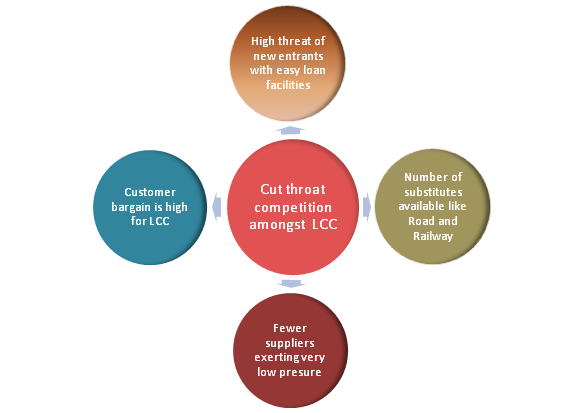
Dynamics mentioned in above picture give a good overview, however there are few factors which come into light when we take a closer look at how domestic airlines operate. We will look at three main factors driving revenue, cost and operations. When these three factors are looked in relation to each other and understood the effect of one on each other, we can then start looking into further details for an opportunistic investment in this sector.
Major source of revenue for domestic airlines comes from passenger travelling. On a broad category, passengers can be divided into two categories, business and vacation travelers. Business travelers are the one who bring profit to airlines as they pay heavy prices for the tickets. Business travelers cannot plan their trip too much in advance and have to depend on last minute schedules. This exposes the major source of revenue exposed to business cycle in the economy. Better the economy, good is the business cycle; more Business travelers are seen in Airport.
Crowd travelling on vacation are smaller contributors to sales. Ironically these customers are more costly to attract and incur heavy expenditure on advertising. Business sense is that the major cost of flying is fixed, so why fly empty. Seats left are better sold at low prices rather than left unoccupied. Eventually profit with this category is lower.
Cost
Airlines have high fixed costs attached to each flight, fuel cost. Jet fuel is a type of aviation fuel designed for use in aircrafts. For the sake of simplicity we will replace Jet fuel with Oil in our discussion. Later we will measure Crude Oil prices to derive an important pattern. Rising Oil prices are an immediate threat to airline industry as it shoots up the fixed cost without adjustments to revenue source or any other reduction in costs
Economies of scale and excess capacity
By far, I would consider this aspect to be the key factor when we come to joining the dots to measure profitability. Put simply, it is the cost advantage an airline gains with expansion. Long run average cost of any firm is the optimal quantity/level it can produce/serve with minimum cost. This is the prime reason why, any airline firm is on aggressive path to expand, either through increase in sales or through acquiring other firm. Very often within this business space, excess capacity is created which then starts denting the profit.
Example: Consider there are 100 customers in a city who make use of domestic airline, and two players offering the service. Each serving 50 customers maintains their long run average cost to minimal. However, if third player in the market enters, it will share the market space. Two players already operating in the market, lose their share without any reduction of average fixed cost. Diseconomies of scale creep in, excess capacity is created.
[End of part 1 . . . Part 2 will be published next week]