
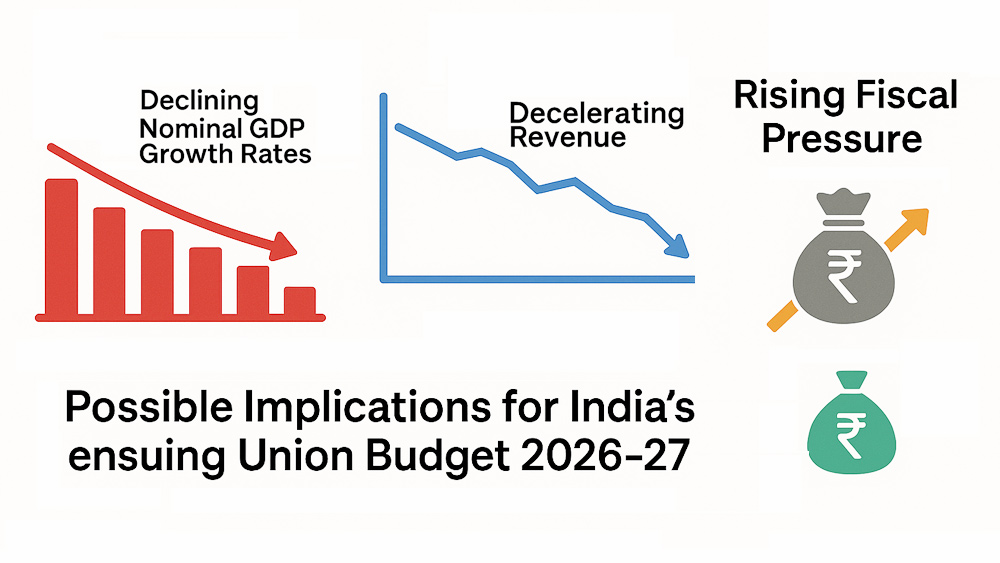
 India’s fiscal strategy in recent years has thrived on a very favorable economic landscape. High nominal GDP growth—driven by post-pandemic recovery in india, rising inflation, and strong price effects—created a substantial revenue cushion. Even moderate tax growth led to strong increases in both direct and indirect tax collections, allowing the Government to pursue fiscal consolidation while increasing capital spending. That phase seems to be ending now.
According to the Government of India’s Ministry of Statistics and Programme Implementation (MoSPI) Press Note dated 7 January 2026 and the past data, the nominal GDP growth has sharply, continuously, and progressively decelerated from 18.9% in 2021-22, to 14.0% 2022-23, then to 12.0% in 2023-24, further down to 9.8% in 2024-25 and finally to 8.0% in FY 2025—26. This continuous and progressive deceleration in nominal GDP growth rate during this four years period of 2022-23 to 2025-26, is not just superficial or temporary. It fundamentally changes the calculations behind tax revenue growth, fiscal forecasts, and budget credibility. In this context, the slowdown in the growth rates of GST and income tax collections during FY 2025-26 should be viewed as more than just occasional underperformance or administrative issues.
The role of nominal GDP growth for fiscal outcomes is crucial. Tax revenues—especially GST and income taxes—reflect nominal, not real, economic growth. When nominal growth exceeds 12-15 percent, tax collections can increase rapidly even without major policy changes. When nominal growth drops to 8 percent, the same tax structure results in significantly weaker outcomes.
The path over the last four years illustrates this point.
As mentioned before, In FY 2022-23, nominal GDP grew by 14.0%, resulting in enough cushion for revenue growth. In FY 2023-24, growth slowed to 12.0% but still remained supportive. FY 2024-25 saw a further dip to 9.8%. FY 2025-26 signifies a still further decline, with nominal GDP growth rate now estimated to be 8.0%.
This is not just a slowdown in economic momentum; it represents a reduction in the revenue-generating base itself. In this environment, expecting tax collections to grow at double-digit rates becomes mathematically inconsistent unless tax buoyancy increases significantly—which does not seem to have happened.
Total Receipts of the Central Government, GST and Income Taxes in FY 2025-26: Growth Rate Deceleration Becomes Binding
The Union Budget for FY 2025-26 was based on significantly higher nominal growth expectations, that is 10.1%, 2.1% higher than the current GDP nominal growth rate of 8.0% that we are actually observing now. Consequently, the Budget Estimates for GST and direct taxes assumed high single-digit to low double-digit growth rates in tax collections.
Actual outcomes indicate a different reality.
While GST collections have remained stable on a monthly basis, year-on-year growth rates have clearly slowed. Consumption growth has decreased, price effects have weakened, and the use of input tax credits remains high.
In fact, the growth rate of Private Final Consumption Expenditure (PFCE) has declined both in terms of nominal as well as real prices during 2025-26. PFCE at nominal prices declined from 12.0% in 2024-25 to 8.2% in 2025-26 and in real terms the PFCE growth rate has declined from 7.2% in 2024-25 to 7.0% in 2025-26. This definitely means less demand and less income growth in nominal terms facing the people. This trend significantly reduces demand and business activity which obviously hampers and weakens the tax collection base. This is more so because currently PFCE broadly accounts for over 55% of GDP at real prices and over 60% of GDP at nominal prices.
Similarly, the primary sector, which includes agriculture on which the majority of the population is dependent and represents the highest percentage of working population, has exhibited decline in its GVA growth rate during 2025-26, both in terms of nominal prices as well as real prices. In terms of nominal prices, the GVA growth rate declined from 9.5% in 2024-25 to 0.2% in 2025-26 while in terms of real prices, the GVA growth rate of the primary sector decreased from 4.4% to 2.7% during the same period. Similar trend is seen in the construction sector too which is considered to be relatively more labour intensive. The GVA growth rate of the construction sector showed decline in 2025-26 compared to 2024-25 both in terms of nominal prices and real prices. While the GVA growth rate of the construction sector in nominal terms declined from 9.4% in 2024-25 to 6.6% in 2025-26, the real GVA growth rate for the construction sector dropped from 9.4% in 2024-25 to 6.6% in 2025-26. The same trend is seen in the Mining and Quarrying Sector also. All this reflects severe weakening the income base of huge numbers of people working in these important sectors accounting for the major chunk of the India’s working population. And naturally, the less income in these important sectors, significantly constrains overall demand and the overall business and investment climate in the country. And this overall decline in the business mood and economic activity adversely affect tax collections in the country.
As a result, overall GST growth has not kept pace with the Budget Estimate in absolute terms.
Income tax collections have shown a similar trend. Growth rate in net direct taxes has slowed compared to previous years, reflecting both economic moderation and policy choices. The move toward the new personal income tax system, which features lower effective rates and higher rebates, has structurally reduced the momentum from personal income taxes. Corporate tax collections have also increased at a slower rate, in line with declining profit growth.
The key point is that the slowdown is in the growth rates themselves, not just a temporary dip. Once growth rates consistently fall below Budget forecasts, achieving absolute tax collection targets becomes quite difficult, even if collections continue to increase in nominal terms.
Why Absolute Tax Collections Are Now Likely to Fall Short of BE 2025-26
With nominal GDP growth dropping to 8.0 percent and tax collection growth rates slowing in tandem, the implications for FY 2025-26 are clear.
The Budget Estimates for tax collections were based on a rapidly expanding nominal economy. When that growth does not happen, tax buoyancy would need to rise significantly to compensate. There is no evidence of such a surge occurring.
As a result, total gross tax collections of the Central Government in FY 2025-26 are now likely to fall short of the Budget Estimates in absolute terms, not just relative to trends or goals. This applies to GST, income taxes, and total tax revenues as a whole.
Non-tax revenues may provide partial support, but they can’t fully offset a widespread slowdown in tax growth caused by deceleration of nominal GDP growth rate.
Will the FY 2025-26 Fiscal Deficit Target Be Breached?
The fiscal deficit target for FY 2025-26 was set at 4.4 percent of GDP, reflecting the Government’s commitment to medium-term stability.
The anticipated shortfall in absolute tax collections raises pressure on this target. However, a significant breach is expected to be salvaged to some extent premised on already good Non-Tax revenue collections during April-November, 2025 as well as by way of rapid expansion in the Non-Tax revenue, effective expenditure management, cutting down relatively less important items of the revenue expenditure, and further prioritizing the capital expenditure during the last four months of FY 2025-26. Indeed, expenditure management remains a powerful tool for adjustments. The Government has shown a consistent ability to manage revenue spending without cutting back on capital investments. In addition, as mentioned before, higher than expected non-tax revenues do provide some relief. Lastly, even with 8.0 percent nominal GDP growth, it still expands the denominator, reducing the impact on deficit ratios.
The most likely outcome seems to be a fiscal deficit close to the Budget Estimate, potentially with some possible slight slippage, but not a serious violation of the FY 2025-26 target. The trade-off will involve a tighter fiscal stance and less flexibility in the year’s final months.
A Brief Reflection What does India’s Tax Receipts & Non-Tax Revenue Actual Data For April-November 2025 (two third of the FY 2025-26) Tell Us
The data from Union Finance Ministry’s Controller General of Accounts suggests a growth of only 3.3% in Net Tax Revenue of the Central Government during April-November 2025 compared to April-November 2024. This clearly indicates significant slippage in Next Tax Revenue collection.
As regards the percentage achievement of the whole FY 2025-26 Budget Estimates target during April-November, 2025, that is, the first eight months or two thirds of the year is concerned, the achievement of the Net Tax Revenue target was 49.5% as compared to 59.8% for the same period of the previous year. However, as discussed before some of this gap is expected to be covered by the Non-Tax Revenue which shows 88.6% achievement of the BE target during the first eight months of the FY 2025-26. But the share of the Non-Tax Revenue in total receipts of the Union Government is not that much as it covers very broadly about 16% to 17% of total receipts of the Union Government.
The data relating to the percentage achievement out of the whole year BE target, during April-November, 2025 for Revenue Receipts as well as Total Receipts tell the same story as Net Tax Revenue as indicated above, explicitly signifying the slow pace of revenue collection compared to same period previous year, that is, April-November, 2024. The percentage achievement during April-November 2025 for Revenue Receipts was 55.9% compared to 59.8% during April-November 2024. Similarly, the percentage achievement during April-November 2025 for Total Receipts was 55.7% compared to 59.1% during April-November 2024. This clearly portrays that till the first eight months of the FY 2025-26, both the momentum and the pace of tax collection seem to be weaker than that of 2024-25 and this must have been largely contributed by the decline in the growth rates of nominal GDP.
Implications for the Union Budget 2026-27: From Optimism to Revenue Realism
The lasting impact of FY 2025-26 on India’s fiscal map will be evident in the crafting of the Union Budget for FY 2026-27.
First, revenue projections will need to become more cautious. With nominal GDP growth rate clearly declining, optimistic assumptions about tax growth will lack credibility.
Second, spending choices will also be more limited. Safeguarding capital expenditure will require sharper prioritization and restraint in current spending.
Third, the pace of fiscal consolidation may slow down. While there will still be a commitment to reducing the deficit, the progress is likely to be more gradual, reflecting revenue realism rather than policy withdrawal.
Fourth, tax policy will focus more on improving compliance and expanding the tax base rather than increasing rates, which could be counterproductive in a slowing nominal economy.
Conclusion: A Quiet but Consequential Fiscal Inflection Point
FY 2025-26 marks a subtle but significant turning point in India’s fiscal narrative. The concurrent declines in nominal GDP growth rates and the growth rate of GST and income tax collections have revealed the limitations of recent revenue optimism in budgets.
While the fiscal deficit target for FY 2025-26 will probably be broadly met, absolute tax collections will most likely fall short of Budget Estimates. This signals the end of the phase of easy revenue. The Union Budget for FY 2026-27 will thus need to consider emphasizing realism, sharper prioritization, and a more disciplined grasp of the new economic environment.
In short, the time when rapid nominal growth saved fiscal calculations is over. What lies ahead is a more challenging period where credibility will depend not on ambition, but on the connection between growth, revenues, and policy choices.