India’s recently released GDP figures have taken analysts by surprise, with Q1 growth soaring to 7.8%—well above earlier estimates. Various agencies had projected growth in the range of 6.3% to 7%, while even the Reserve Bank of India expected only 6.5%, given the global headwinds of U.S. tariff measures, geopolitical uncertainties, and slowing demand worldwide. Yet, India has once again reaffirmed its position as one of the fastest-growing economies in the world. The key question now is whether this robust momentum can be sustained in the coming quarters, or this growth appears to be short-term driven by front-loading, as businesses accelerated activity in anticipation of potential tariff pressures in the future.
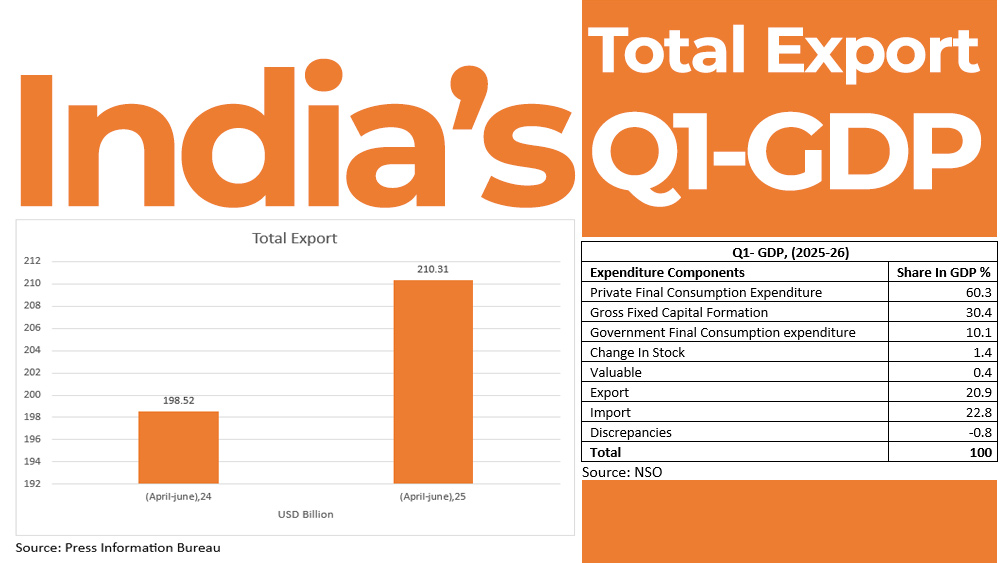 India’s export performance in Q1 (April–June) 2025 recorded a 6% increase, rising from USD 198.52 billion in Q1, 2024 to USD 210.31 billion. While this growth appears encouraging at first glance, it is important to account for the nearly 5% year-on-year inflation, which indicates that the rise may be driven by price effects also rather than solely an actual increase in export volumes. Moreover, an analysis of GDP expenditure components table reveals that exports have a relatively smaller contribution to overall GDP. The major push to growth has come from domestic consumption and investment, highlighting that the impressive Q1 performance cannot be credited to exports, especially when part of the increase reflects front-loading in anticipation of future tariff pressures. This momentum is, in fact, being sustained by strong domestic demand and robust investment activity.
India’s robust domestic demand is strongly supported by improving employment trends. The unemployment rate, which averaged 8.4% between 2018 and 2025, has declined significantly in recent months—dropping to a record low of 5.1% in April 2025, followed by 5.6% in May and June, and easing again to 5.2% in July. This fall below the average reflects stronger labour market conditions, which have boosted household purchasing power and contributed to sustained demand in the economy.
Alongside this, inflation has also been on a steady downward trajectory since January 2025, making goods and services more affordable and encouraging consumption. An economy that manages to maintain high employment while keeping inflation in check signals resilience and sound fundamentals. This balance highlights improvements in productivity, efficient supply chain management, and effective & timely policy interventions that have collectively reinforced India’s growth momentum.
As per the recently released data, India’s Index of Industrial Production (IIP) recorded a growth of 3.5% in July 2025, up from 1.5% in June. This improvement was largely driven by a 5.4% expansion in the manufacturing sector, signalling strong underlying demand in the economy. All these numbers, coming ahead of the festive and marriage season, indicate that, this momentum is expected to continue in peak festival , supporting consumption and providing further impetus to GDP growth in the coming quarters.
A sharp rise in government Capex has emerged as a key driver of India’s recent growth momentum. In April–June 2025, the Centre’s gross capital expenditure surged by 52% year-on-year to ₹2.8 lakh crore, a significant acceleration compared with the 33.4% growth recorded in the previous quarter and a sharp reversal from the 35% contraction seen in the same period last year. This sustained focus on public investment has not only boosted infrastructure development but also stimulated private sector activity by creating demand for materials, machinery, and services. Higher capital outlays thus serve a dual purpose—expanding long-term productive capacity while providing an immediate push to GDP growth.
Overall Gross Value Added (GVA) has risen from 6.5% in FY 2024-25 to 7.6% in FY 2025-26, with manufacturing and services emerging as the key growth engines in the GDP Growth, recording growth rates of 7% and 9.3% respectively. This progress has been underpinned by continuous policy efforts by government to strengthen these sectors through targeted incentives and reforms. Initiatives such as the Business Reforms Action Plan (BRAP) and the National Single Window System (NSWS) have streamlined procedures and eased compliance, fostering a business-friendly climate. Complementing these, the Production Linked Incentive (PLI) schemes—allocated ₹19,482.58 crore for FY 2025-26, over 108% higher than last year—are further boosting industrial competitiveness and service sector growth and many more.
Looking ahead, timely policy interventions will remain crucial in strengthening India’s economic resilience and global standing. For instance, SEBI’s efforts to enhance financial awareness have empowered domestic institutional investors (DIIs) to play a stabilizing role in the markets. Even amid heavy foreign institutional investor (FII) outflows triggered by tariffs and global uncertainties, Indian markets avoided a sharp downturn as DIIs held firm. Similarly, the government’s introduction of GST 2.0—streamlining tax rates into two main slabs of 5% and 18% by removing the 12% and 28% categories—is poised to provide a strong boost to future demand, reinforcing the economy’s growth trajectory
India’s robust GDP growth has emerged as a saviour at a time when the U.S. are imposing new trade restrictions. By actively pursuing free trade agreements (FTAs) and expanding the scope of goods and services in global markets, India is positioning itself to counter external pressures with resilience. These strong numbers not only underscore the strength of the Indian economy but also enhance the country’s negotiation power in international negotiations, enabling it to secure more favourable trade deals and advance its long-term strategic interests.